Jon Krakauer
The ClimbJon Krakauer is a Seattle-based journalist, best-selling author, and climber whose place on the 1996 Everest expedition became inseparable from the account he later published of the disaster. He was both a client moving through the summit-day crisis and a reporter interpreting it afterward. That double position gave his writing unusual proximity to events—and made his judgment of Anatoli Boukreev a central subject of the controversy that followed.
Assignment and Change of Expedition
Outside commissioned Krakauer to write a feature on the commercial expedition boom on Mount Everest and sought to buy him a place on Scott Fischer’s Mountain Madness team. The negotiations paired editorial access with commercial interests: in return for a discounted climbing place, Mountain Madness hoped for advertising space and a richly illustrated feature containing promotional copy. Krakauer himself favored Fischer’s team, telling an associate that it had better climbers and describing Fischer as a local and an interesting character.
The proposed deal became a dispute over price. A Mountain Madness associate recalled that Outside wanted the company to subsidize Krakauer’s place below cost, leaving Mountain Madness to pay part of the bill. At the last moment, Outside turned to Rob Hall, who offered a lower price. The magazine bought Krakauer’s place from Hall’s Adventure Consultants instead. Outside later said its choice was not solely financial: it also considered Hall’s greater experience guiding on Everest, his safety record, and what Krakauer regarded as a better oxygen system. The decision changed Krakauer’s expedition affiliation before it changed the subject of his reporting: he would cover the commercial climb from Hall’s team rather than Fischer’s.
The Summit-Day Climb
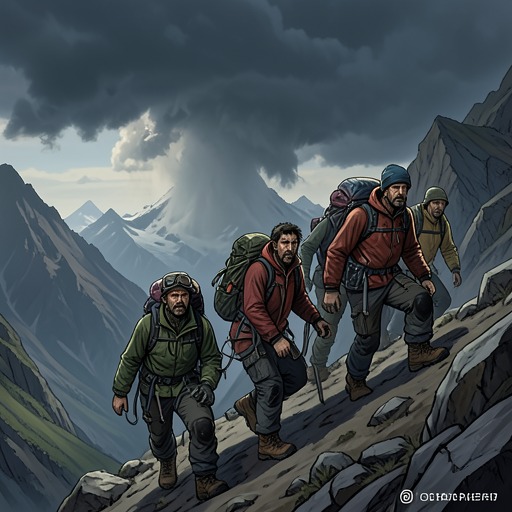
On summit day, Krakauer climbed with Hall’s expedition, among a group whose movement was controlled by Hall’s instruction that clients remain within one hundred meters of one another during the first half of the ascent, up to the Balcony at about 8,500 meters. Krakauer, used to making independent decisions while climbing, later described frustration at having his choices constrained by the least capable members of the group. The rule repeatedly checked the climbers’ progress; he and Ang Dorje Sherpa reached the Balcony at 5:30 a.m. after stop-and-go movement that had cost them more than an hour, and sat there rather than continuing higher.
Higher on the route, Krakauer was among the climbers who followed Anatoli Boukreev’s trail toward the summit. After reaching the top of the Hillary Step, he tied in; Neal Beidleman and Hall’s guide Andy Harris came behind him. At 1:12 p.m., Krakauer reached the summit, with Harris following shortly afterward. Beidleman, who was moving slowly, asked Martin Adams to turn up his oxygen, then asked for it to be increased again near the summit; Adams opened it fully.
The descent exposed the fragility of the route and its equipment. Near the South Summit, Adams found Krakauer slumped in the snow, holding the head of his ice axe while its handle was driven into the surface as a makeshift self-belay. Neither climber was clipped to a fixed rope. Mike Groom, another of Hall’s guides, gave Krakauer his oxygen canister; Krakauer accepted it, reached the South Summit within minutes, took another canister from the oxygen cached there, attached it to his regulator, and continued down. The episode placed him on both sides of the expedition’s later arguments: he had firsthand experience of oxygen shortages and precarious descent, but his account of other climbers’ decisions would also be contested.
A later dispute about the fixed ropes further complicated the reconstruction. Lopsang Jangbu Sherpa said a member of a Montenegrin expedition that had attempted the summit the previous day told him that the rope was already fixed and there was no need to carry more. Krakauer questioned that explanation in his published account. He argued that guides who should have been informed of a change in plans had not been told, and pointed out that Lopsang and Ang Dorje had left Camp IV carrying three hundred feet of rope—an action he considered inexplicable if the route were already secured. The disagreement shows how the book’s account did not merely report the climb: it assessed testimony and used the practical details of equipment and communication to test it.
From Magazine Feature to Book
Krakauer’s article, “Into Thin Air,” appeared in the September 1996 issue of Outside. It criticized Boukreev’s decision to descend ahead of clients on summit day and questioned his failure to use supplemental oxygen. Nine months later, in April 1997, Krakauer published Into Thin Air, an expanded version of the article. Although he had conducted extensive interviews after the magazine piece, the book’s position on Boukreev’s role changed little.
The published book nevertheless included Boukreev’s explanation of his descent, taken from an interview with Pete Wilkinson that had been given to Krakauer in June 1996. Boukreev said he had stayed on the summit for about an hour, that the cold and inactivity were draining his strength, and that he would be more useful back at Camp IV, where he could take oxygen up to returning climbers or assist anyone who became weak. Krakauer continued to argue that Boukreev should have used oxygen; in his postscript, he connected Boukreev’s nonuse of it to the decision to leave clients on the summit ridge and descend quickly. The dispute therefore concerned not just what Boukreev did, but how his stated reasoning, the physical conditions, and the obligation to remain with clients should be weighed.
Krakauer’s account also became entangled with competing recollections of oxygen supplies. In his book, he said that at least six Adventure Consultants bottles remained at the South Summit when he, Harris, Groom, and Yasuko Namba arrived. Groom’s published account described distributing full bottles to Harris, Namba, and Krakauer, taking one for himself, and seeing two more taken by Hall’s Sherpas Ang Dorje and Ngawang Norbu. If no more than six bottles were present and Groom’s allocation was accurate, the cache would have been empty by the time Hall—and perhaps Doug Hansen—reached the South Summit. Yet Krakauer also wrote that Hall possessed two full canisters when he arrived there. The figures and accounts do not settle neatly into a single version; the discrepancy became part of the book’s evidentiary burden.
The Boukreev Dispute
The conflict between Krakauer and Boukreev began publicly with the Outside article’s criticism of Boukreev’s descent. Boukreev later complained that Krakauer’s article had omitted his explanation that Fischer approved the descent. In a letter addressing the criticism, Boukreev pointed out that Krakauer had access to an interview transcript in which he had explained both his reasoning and Fischer’s approval; he also said the transcript had been available to Outside’s editorial and fact-checking staff before publication. Boukreev questioned why Krakauer had not contacted him to clarify the matter, noting that his telephone and fax details were known.
The disagreement widened beyond the descent. Krakauer repeatedly faulted Boukreev for climbing without oxygen, arguing in his postscript that this had effectively determined his rapid descent from the summit ridge. Boukreev’s defenders countered that his explanation and Fischer’s approval were important evidence. G. Weston DeWalt argued that Krakauer had chosen to omit both Boukreev’s account and Fischer’s reported plan to have Boukreev descend ahead of clients, thereby presenting judgment without giving readers all the available evidence. The disagreement is not simply between two climbers’ memories: it is also a contest over what counts as adequate reporting, which evidence must be disclosed, and how much certainty a published narrative can claim.
The American Alpine Club’s David A. Sowles Memorial Award offered a sharply different assessment of Boukreev’s conduct. In December 1997, the club honored him unanimously for repeated efforts to search for and save three exhausted teammates trapped by the South Col storm, and for his final, dangerous attempt to reach Fischer. Krakauer, who attended the club’s annual meeting, wrote two days after the ceremony to Jed Williamson, one of the award committee members. His accusatory letter, circulated to people in publishing, mountaineering, and journalism, attacked Boukreev, DeWalt, and The Climb. At a later panel, Boukreev urged greater care from journalists writing about high-altitude mountaineering. During questions, Krakauer called The Climb dishonest and accused Boukreev of discouraging a free press on Everest; the other panelists did not respond.
The dispute also became a problem of representation. When Boukreev watched a television dramatization of the disaster, he laughed at the actor’s portrayal of him as imposing and belligerent, a simplified malcontent. The episode made visible how the competing accounts could harden into public characterizations: the climber’s actions were argued over, but so was the figure audiences were invited to see. Krakauer’s writing, Boukreev’s rebuttals, institutional recognition, and screen adaptation became parts of the same struggle over the disaster’s meaning.
Evidence, Memory, and Narrative Judgment
Krakauer’s position was unusually difficult to separate into observer and participant. His account drew authority from his presence on the route: he experienced the enforced spacing on the ascent, reached the summit at 1:12 p.m., encountered the descent without a fixed-rope connection, and depended on Groom’s oxygen before taking a cached bottle at the South Summit. Yet the same closeness placed his judgments under scrutiny. Boukreev said their interview was narrowly focused and that Krakauer appeared frustrated by the limits of his English; to communicate more fully, Boukreev gave him a photocopy of answers he had supplied to Wilkinson. The book later quoted part of that material, while the controversy centered on whether quoting it adequately represented the explanation it contained.
The disagreement over fact-checking sharpened this tension. Krakauer disputed DeWalt’s claim that Outside had failed to check certain details with Boukreev before publication. DeWalt, in turn, pointed to errors that he said Boukreev noticed in the article, including Krakauer’s description of Boukreev as relatively lightly dressed on summit day; photographs supplied to Outside before publication, DeWalt argued, showed Boukreev adequately dressed. The contention was not only about a phrase or an image. It raised the question of how firsthand reporting can be tested when accounts are shaped by incomplete recollection, editorial decisions, and the later publication of competing narratives.
Krakauer’s role thus extends beyond that of a climber who survived a dangerous descent or a journalist who wrote a widely expanded account. He became one of the disaster’s principal interpreters, and his judgments helped define the public argument about Boukreev’s responsibility. The evidence preserves both the specificity that makes his account compelling—the one-hundred-meter spacing rule, the oxygen at the South Summit, the rope carried from Camp IV—and the unresolved discrepancies that resist a single, uncontested story. His significance lies in that double effect: he brought the reader close to the climb while making the authority of the account itself part of the controversy.